

The 4Cs are the only universal language for describing a polished diamond. Understanding them — and, more importantly, knowing which ones to prioritise — is the difference between a stone that sparkles for a lifetime and one that looks dull the day you bring it home. After 50 years of diamond buying for our Murray Place workshop, here's how we explain the 4Cs to first-time buyers.
Cut — the only 'C' you should never compromise on
Of the four, Cut is the king. It is the only attribute fully controlled by human craft, and it determines how much of the light entering the diamond bounces back to your eye as sparkle. A poorly-cut diamond will look dull regardless of how high its colour and clarity grades are.
GIA grades cut on a 5-point scale: Excellent, Very Good, Good, Fair, Poor. We refuse to stock anything below Very Good. Within Excellent there are subtle gradations — a 'triple Excellent' (cut, polish, symmetry all Excellent) commands a small premium and is worth paying for on stones above 0.50ct.
The proportions that matter most are table percentage (54–58%), depth percentage (60–62.5%) and crown angle (34–35°) for a round brilliant. Stones outside these windows are either too shallow (looking lifeless) or too deep (hiding weight in the pavilion you don't see face-up).
Colour — pay for what you can see, not what's on paper
Diamond colour is graded D (colourless) to Z (light yellow). The differences between adjacent grades are tiny and often invisible without lab conditions and a master comparison set.
Practical advice for UK buyers in 2026:
- D, E, F (colourless) — only worth paying for if you're a collector or buying very large stones (2ct+). The visual difference vs G/H is invisible in a mounted ring.
- G, H (near-colourless) — the sweet spot for white metal. Looks white, sensible price.
- I, J (faint) — fine in yellow gold, where the warm metal masks the slight tint. In platinum, only choose I/J if budget is tight.
- K and below — visible warmth, only for vintage-styled or yellow-gold pieces.
Clarity — eye-clean is the goal, not Flawless
Clarity grades the size, position and visibility of inclusions inside the diamond. The scale runs Flawless → IF → VVS1 → VVS2 → VS1 → VS2 → SI1 → SI2 → I1 → I2 → I3.
The goal for almost every buyer should be eye-clean — meaning no inclusion is visible without magnification. In a well-cut round brilliant, SI1 is reliably eye-clean, and SI2 often is depending on where the inclusion sits (a feather near the girdle hides; a black crystal in the table does not). Always look at the GIA plot before buying SI2.
Anything VS2 or above is eye-clean by definition. VVS and Flawless are invisible to the unaided eye and primarily exist for collector-grade or investment stones.
Carat — hit a 'magic size' and pay for cut
Carat measures weight. 1 carat = 0.20 grams. Because the market psychologically values round numbers, prices jump at 'magic sizes': 0.50, 0.70, 1.00, 1.50 and 2.00ct.
A 1.00ct H/SI1 round brilliant might cost £4,800. A 0.95ct of identical quality might cost £3,800 — same face-up size, 20% saving, just because it doesn't cross the threshold. If your budget is tight, dropping 'just under' is a smart move. If you want the magic-size paperwork for resale, pay the premium.
How to read a GIA certificate in 60 seconds
- Report number — verify it on gia.edu/report-check before paying.
- Shape & measurements — sanity-check vs the physical stone with a digital gauge.
- Carat weight — exact to two decimal places.
- Cut grade — must be Very Good or Excellent.
- Colour & clarity — match what you saw on the plot.
- Proportions — table %, depth %, crown angle, pavilion angle, all within ideal windows.
- Plot diagram — your jeweller should walk you through every red mark (inclusion) and green mark (surface feature) under a 10× loupe.
Where we'd compromise — and where we wouldn't
In our boutique on Murray Place we'll happily build you a stunning engagement ring at almost any budget — but the order of priorities never changes. Cut first, then carat (hit the magic size you can afford), then colour, then clarity. Skip a colour grade before you skip a cut grade. Skip a clarity grade before you skip a carat magic size.
If you'd like to see how the 4Cs translate in person, we keep a teaching tray of 12 diamonds spanning the colour and clarity spectrum, side by side under daylight-balanced lighting. Walk in any day or call 01786 462799 to book.
Shop the look
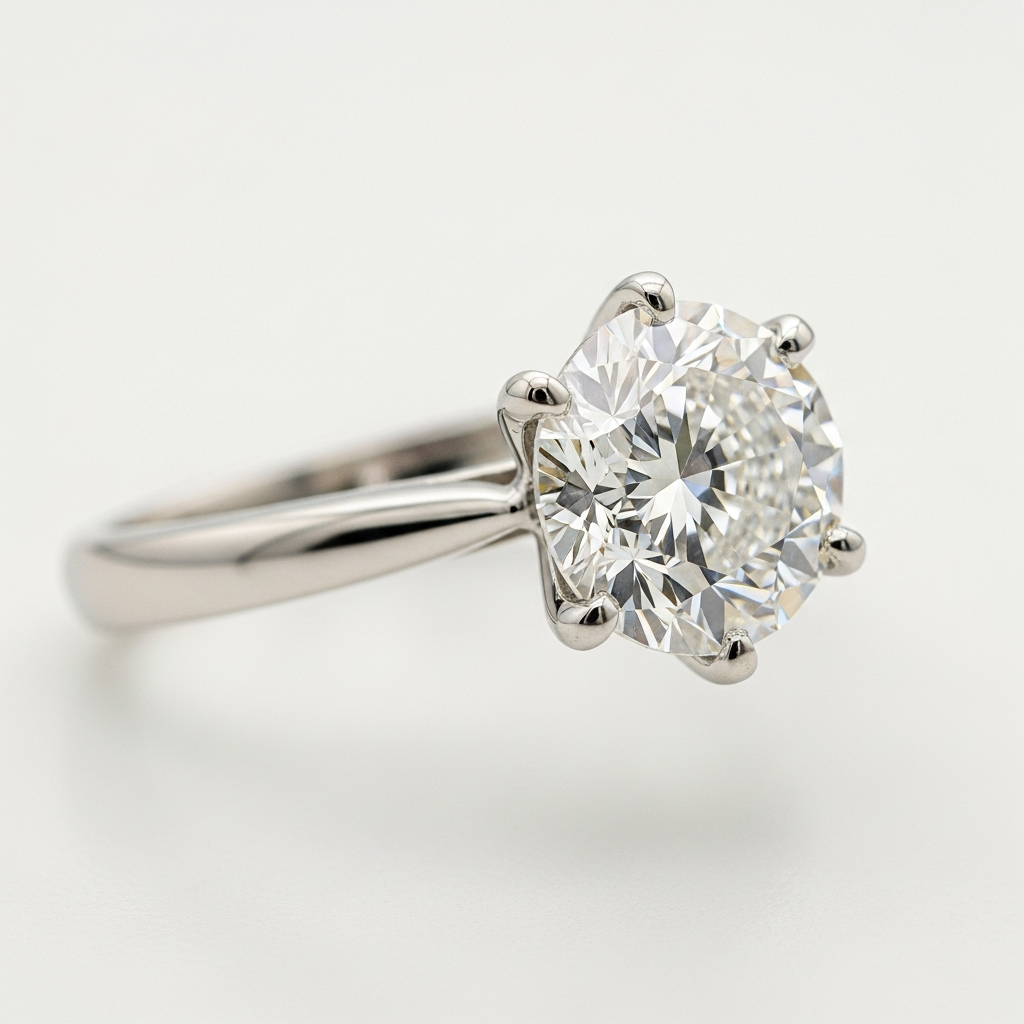
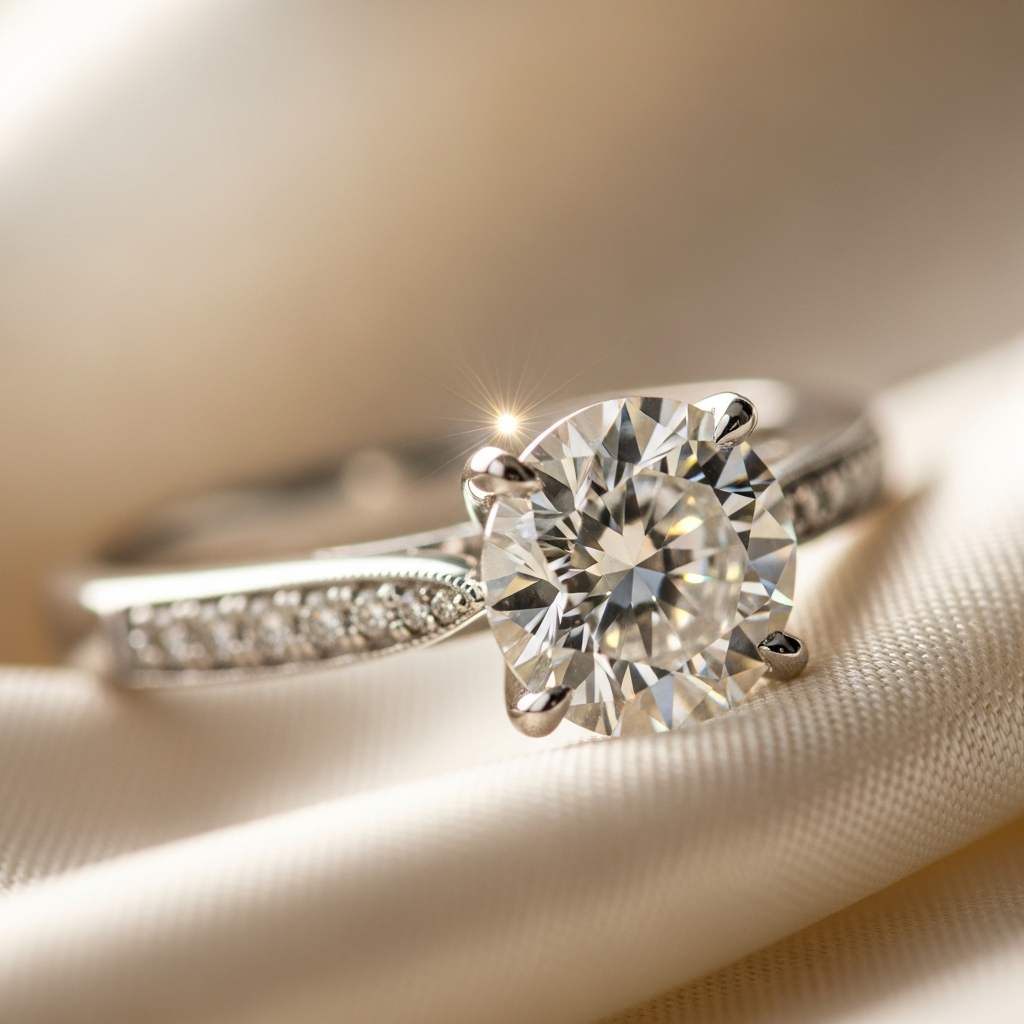
Pieces from our Stirling boutique that pair beautifully with this article.
- Share of UK diamonds graded by GIA
- ~78%
- Eye-clean threshold for clarity
- SI1 (in well-cut rounds)
- Cut quality grades available from GIA
- 5 (Excellent → Poor)
Source: GIA — 2024 Annual Report
Source: GIA — Clarity Plotting
Source: GIA — Cut Grading System
“If a customer can only afford to optimise one of the 4Cs, it is always Cut. A poorly-cut D Flawless will look duller than a well-cut H SI1, and at half the price.”
Frequently asked questions
Sources & further reading
- [1] GIA — The 4Cs of Diamond Quality — Gemological Institute of America (accessed 2026-04-15)
- [2] GIA — Diamond Cut Grading System — Gemological Institute of America (accessed 2026-04-15)
- [3] IGI — Diamond Reports — International Gemological Institute (accessed 2026-04-15)
People also ask
- Are lab-grown diamonds graded the same way?
- What is the difference between GIA and IGI grading?
- How accurate is diamond colour grading?
- What is fluorescence in a diamond?
Related reading
Buying Advice
How to Choose an Engagement Ring (UK Buyer's Guide 2026)
Diamond cut, metal choice, certification, finance and bespoke options — a Stirling jeweller's complete UK buyer's guide for 2026.
Guides
Lab-Grown vs Natural Diamonds: An Honest Comparison
Identical chemistry, very different price curves. A Stirling jeweller's plain-English comparison of lab-grown vs mined diamonds for engagement rings in 2026.

Education
CVD vs HPHT Lab-Grown Diamonds: What's the Difference?
Two methods grow lab diamonds — CVD and HPHT. A Stirling jeweller with GIA training explains what each method produces, which to prefer, and whether it matters for an engagement ring.